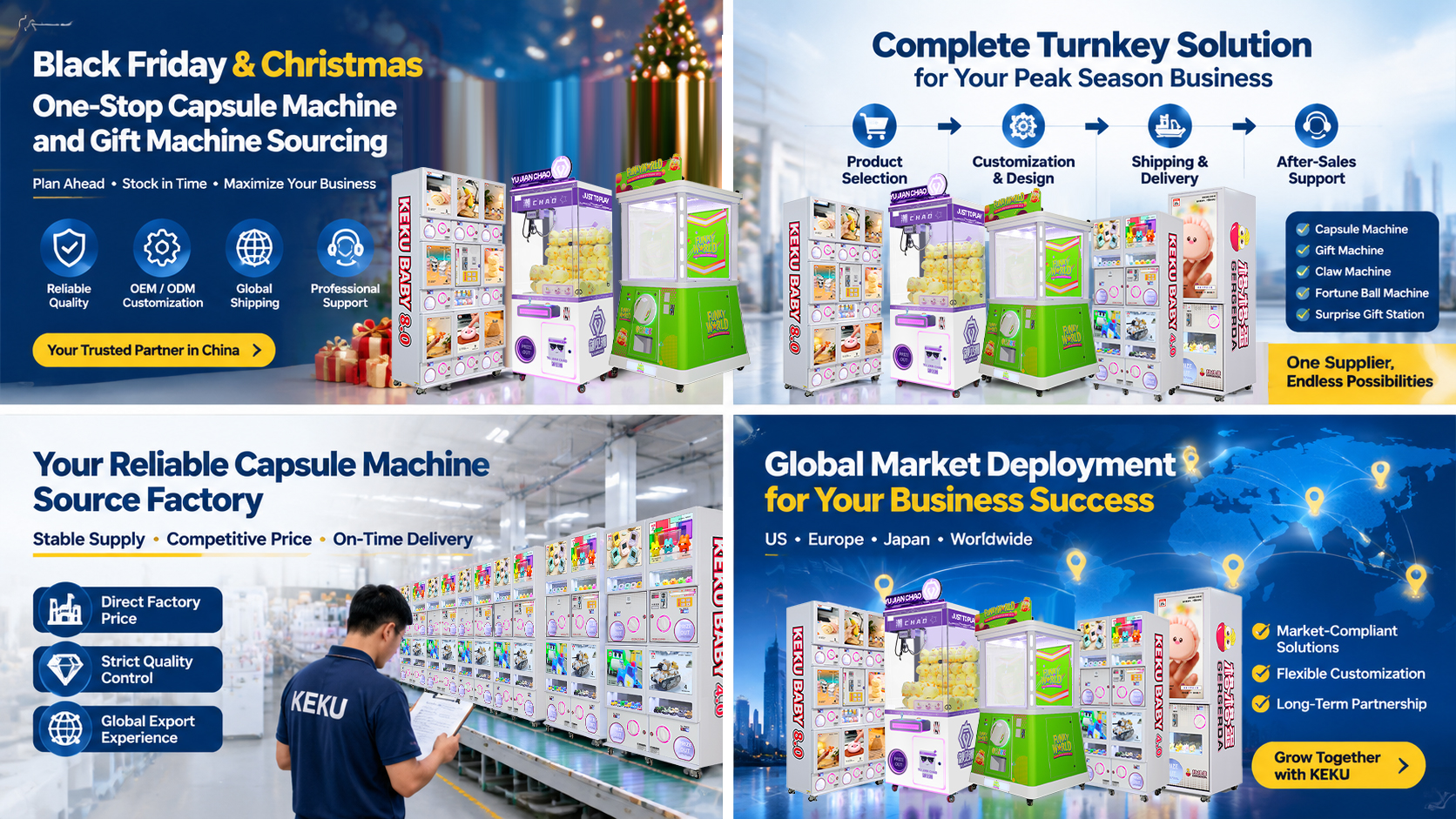
one-stop capsule machine and gift machine sourcing
Introduction
Black Friday pulls in global retail attention, and Christmas turns that attention into steady foot traffic. From Christmas markets in Europe to year-end displays in Japan, this is the stretch of the year when buying intent is most concentrated. For buyers making one-stop capsule machine and gift machine sourcing, what is worth discussing is not a price list but a package that can be deployed as it stands. This article is written by KEKU Technology for two kinds of readers: operators already running sites who need restocking and machine tuning, and new buyers planning the next season and getting ready for Black Friday capsule machine stocking.
1. Why peak-season stocking has to be one-stop: four links that cannot be pulled apart
From purchase order to opening day, a machine has to pass four gates: production scheduling, ocean freight, customs clearance, and installation and commissioning. Black Friday capsule machine stocking and Christmas peak-season site deployment fall into the same window, so splitting these four gates across different suppliers does not add risk up — it multiplies it.
1. The chain must arrive complete: machines, prizes, payment and documents cannot be bought separately
Whether a machine can open on time in the holiday window depends on four things landing together: production scheduling, shipping and customs clearance, payment and language configuration, and certification documents. Tight peak-season space and congested destination ports are the norm, and factory work such as colour changes, artwork changes and certification sample builds all compete for the same line. Spread these steps across different suppliers and any single failure travels straight to the whole site.
The real question is not how fast one link runs, but whether the four links line up: what prize structure the machine is built around, which market the payment is configured for, and which certification system the documents follow should all be settled before the order is placed, not patched after the goods land.
2.Machine and prize matching: get the size wrong and even a good machine runs empty
Capsule machines must match the capsule size — 32, 45, 50, 60 and 75 mm each have their own hopper and dispensing structure; claw machines must match claw strength and drop chute to the size and weight of the prize; Surprise Gift Station must match prizes to compartments — an 8-, 10- or 27-compartment satellite does not carry the same kind of goods, and the blind-box satellite is a category of its own. If the prize structure is not fixed, machine selection has not really started. At the order stage KEKU asks clients for a prize list and a per-unit cost band first, then works back to the machine and compartment mix, so the order never runs “buy the machine, then look for prizes”.
3. Payment and localisation: set at the factory, ten times cheaper than rewiring on site
US sites run mainly on bill validators plus credit cards and mobile payment; Europe leans clearly towards cashless and contactless; Japan still runs mainly on ¥100 coins and needs change-giving (two-note) capability plus QR code. Voltage 110V or 220V, panel language, price labels and price per play all have to be set before shipment. Change them on site and you are changing harnesses, mainboard parameters and panel silkscreen — schedule and cost both slip out of control.
4.Compliance documents and spare parts: one gets you in, the other keeps you running
The US market looks at CPSIA and ASTM F963 toy safety testing plus whole-machine electrical safety certification; Europe requires CE with EN71 toy testing and, separately, packaging EPR registration in countries such as Germany and France; Japan requires PSE certification for electrical appliances and the ST toy mark. Sell into a market and the documents must be issued for that market alone — one set cannot cover everything. On spares, claws, belts, coin acceptors, mainboards and LED strips should ship with the container at 3% to 5% of the machine count: a site going down in peak season costs far more than a full spares kit. This is where a capsule machine source factory earns its place — machines, prizes, spares and certification files come off the same line, so there is exactly one party to call when something goes wrong.
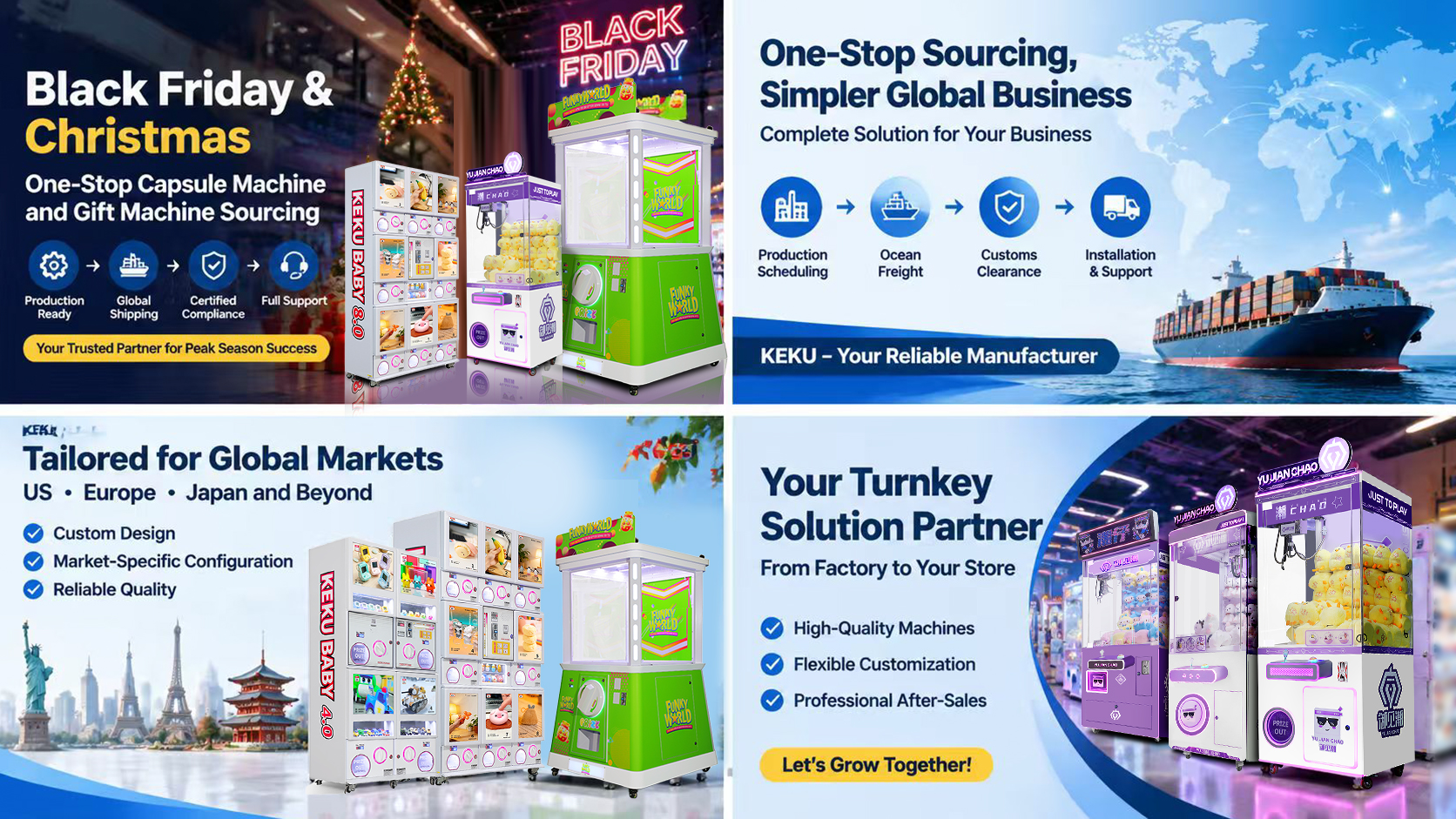
Black Friday capsule machine stocking
2. The three market blocs: machine mix, deployment results and site types
Habits differ sharply across the US, Europe and Japan: the US buys the “one family play” experience, Europe buys “a coin of surprise inside a market stall”, Japan buys “a display feel that sets it apart from the capsule corner next door”. One product line has to be recombined market by market.
1. United States: claw machines + Fortune Ball
1. Market read
The core offline entertainment venues in the US are family entertainment centres (FEC), cinema lobbies, bowling alleys and mall atriums. Across the Black Friday and Christmas window, family traffic is highly concentrated and the cost of letting a child “play a couple of rounds” is very low. Claw machines are no novelty in the US, claw machine manufacturers are dense and the category is heavily homogenised — what actually separates operators is the prize ladder, the brightness of the cabinet, and whether the winning moment is visible to bystanders.
2. Machine mix
The mainstays are Crazy Party, Fun Party and Lucky Party two- and three-player claw machines, covering multi-unit demand at high-traffic sites; YUJIANCHAO series, with its all-metal cabinet, purple-and-white palette and “multi-player, vivid lighting” structure, suits corridor entrances where it pulls traffic in; Fortune Ball gift machine, built around ball play and delivering a guaranteed prize, runs a fast cycle and fast turnover, so it sits at the end of the claw machine row to catch customers who missed the claw but still want one more round.
3. Deployment observations
Where the prize window is lit and open, dwell time among onlookers is clearly longer than at an ordinary claw machine, and the same family re-feeds coins more often. Building the prize ladder (small keychains, mid-size plush, large licensed plush) holds repeat play better than simply raising claw strength: customers know what the next round might win. When Fortune Ball stands beside claw machines, the usual result is a higher basket rather than cannibalisation — it absorbs the marginal customers who would otherwise have walked out. These are general field observations; actual output still depends on site rent, traffic mix and prize cost.
Table 1 US site configuration and deployment points
| Site type | Audience and peak hours | Recommended machines | Deployment observations | Operations and compliance |
| FEC (family entertainment centre) | Families; all day at weekends, school holidays | Crazy Party, Fun Party two- and three-player | Queuing at multi-unit positions creates herd effect; turnover peaks on holidays | Prize ladder must be spread wide; CPSIA and ASTM F963 files ship with goods |
| Cinema lobby | Teens and couples; evening shows and weekends | YUJIANCHAO series | Prize window draws a crowd; short bursts when shows let out | Prize unit price can go higher; bill validator and card payment are the main mix |
| Mall atrium | All audiences; all day through Black Friday and Christmas | Claw machines + Fortune Ball combo | Fortune Ball catches younger families and lifts the basket | Cabinet finish must match mall decor; check site power capacity |
| Bowling alleys and family restaurants | Families and groups; evenings and weekends | Fortune Ball as the main unit, plus one claw machine | Low price, high frequency; strong conversion during waiting time | Prize restocking radius must be short; single-unit sites first |
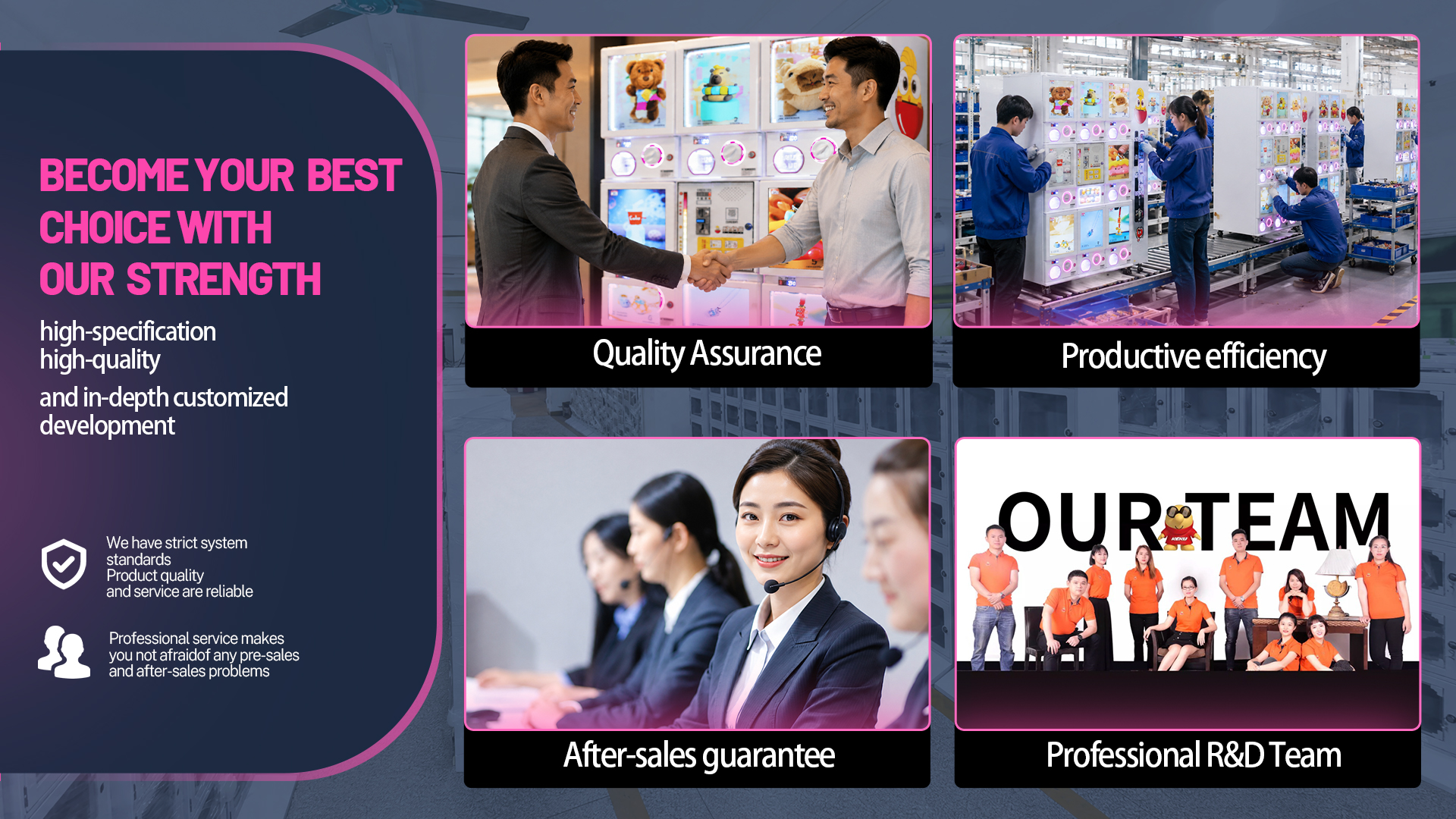
Cross-Border Commercial Capsule Machine
2.Europe: the full capsule range
1. Market read
Europe’s peak season is not in malls but in Christmas markets. Through the Christmas season, markets open back to back in Germany, France, Austria and the Nordics: high footfall density, long dwell time, low ticket value. Capsule machines sit exactly in that price band — one coin, one random result, and a child can open it on the spot. European buyers care about three things: whether the cabinet fits the warm light and timber stalls, whether cashless payment works, and whether the certification documents are complete. The Christmas peak-season site deployment window is short, so all three have to be confirmed before entry.
2. Machine mix
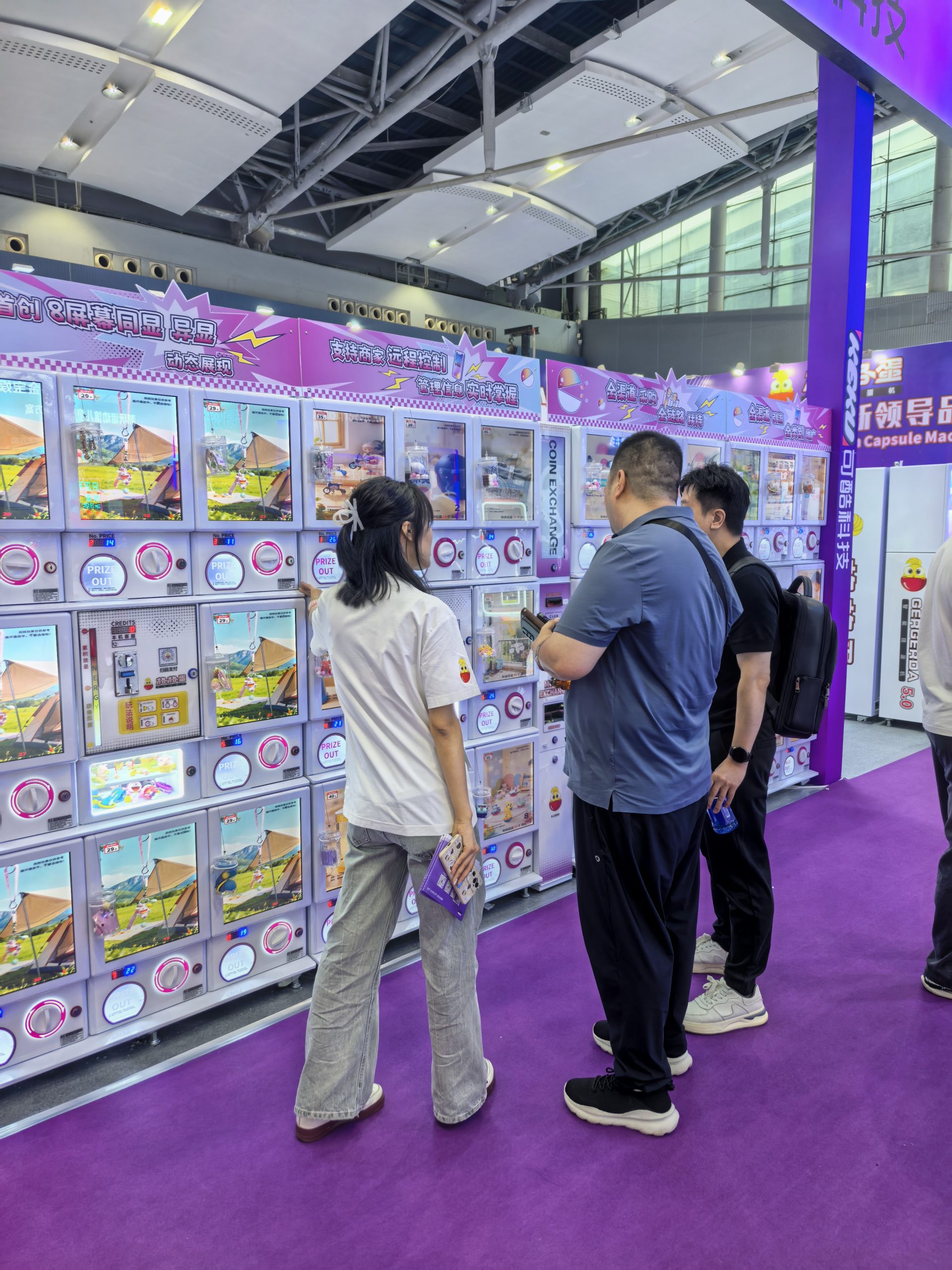
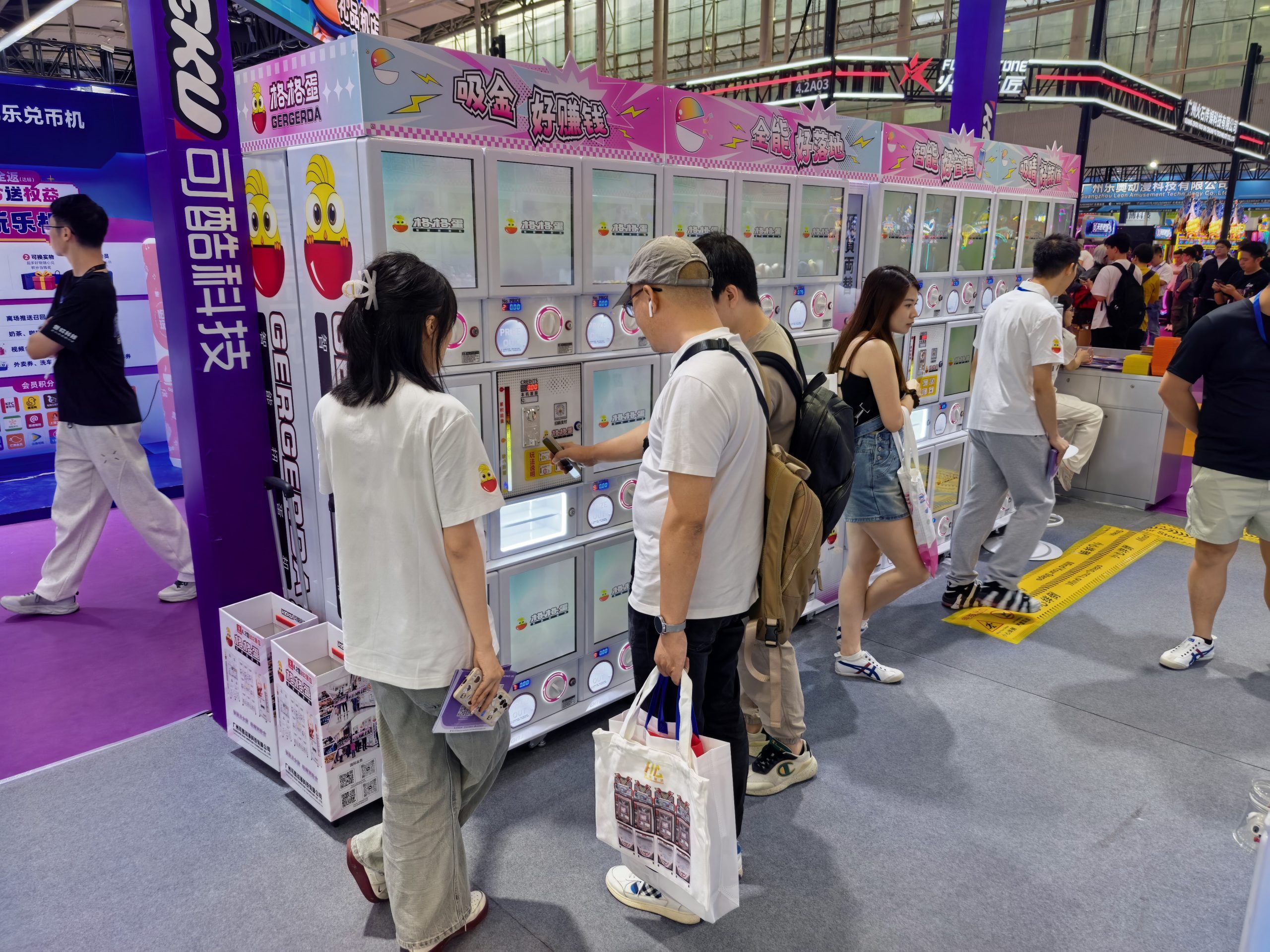
GERGERDA capsule machine 4.0/5.0/8.0 covers footprints from a single unit to multi-linked banks: 5.0 is a five-cabinet bank with five built-in HD screens looping prize visuals, so several people can play at once without queuing; 4.0 and 8.0 suit narrow footprints such as small shops and supermarket exits. KEKU BABY 4.0 and 8.0 are built around the screen-wall effect, with 8.0 carrying eight independent HD screens, suited to malls, toy stores and transport hubs. Commercial capsule machines use a self-developed payment module that supports multi-channel collection and remote management, suited to unmanned and chain sites.
3. Deployment observations
Market sales peak on weekend evenings and when the holiday atmosphere is strongest, so the machine must keep dispensing smoothly under short, dense bursts; one jammed capsule costs far more in lost goodwill than the price gap between machines. At a market, the five-bank plus screen-wall combination reads like a small stall, parents treat it as a photo spot, and what it really buys is dwell time rather than a bigger single ticket; at the same position, linked units generally out-earn a single machine of equal footprint, because the queue itself creates herd behaviour.
Table 2 European site configuration and deployment points
| Site type | Audience and peak hours | Recommended machines | Deployment observations | Operations and compliance |
| Christmas market stall | Families and tourists; weekend evenings and holiday period | GERGERDA 5.0 five-cabinet bank | Screen wall creates a stall presence; dwell and photos drive extra plays | Rain and damp protection; CE and EN71 files on hand |
| Shopping centres and supermarket exits | All audiences; afternoon to evening | GERGERDA 4.0/8.0, KEKU BABY 4.0 | High conversion at exit positions; low ticket but steady frequency | Check aisle width and fire-safety requirements |
| Railway stations and airports | Commuters and travellers; morning and evening peaks | Commercial capsule machine (unmanned) | Unmanned plus cashless; a single unit runs steadily long term | Remote management; EPR packaging registration |
| Toy stores and bookstores | Families with children; weekends | KEKU BABY 4.0/8.0 | Complements the shelf assortment; prizes can be cross-promoted in store | Prize selection must match the store positioning |
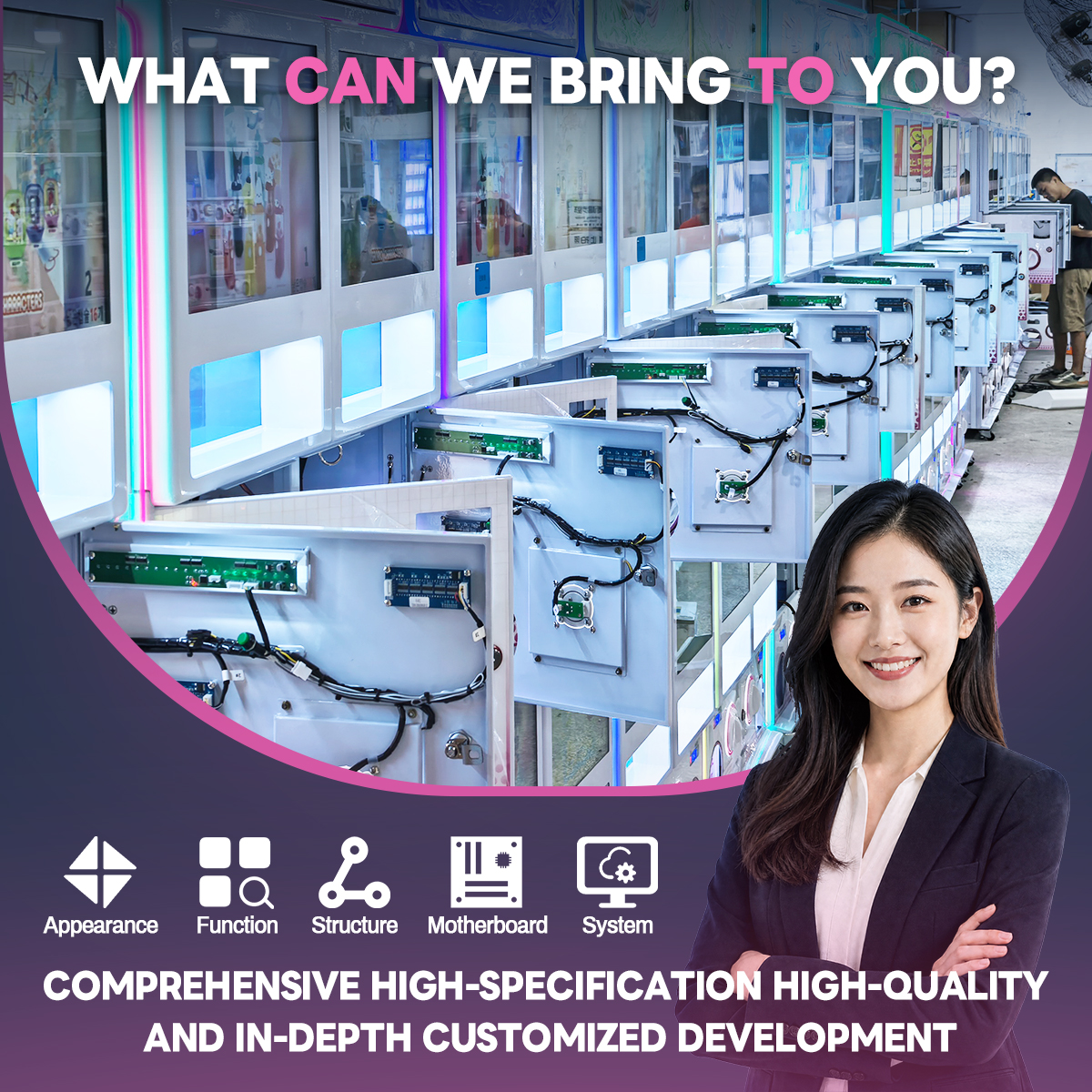
Capsule Machines
3.Japan: Fortune Ball + Surprise Gift Station + claw machines
1. Market read
Japan is the home market of the capsule machine and capsule density is extremely high, so an ordinary capsule machine can hardly win a good position. What Japanese buyers actually lack is experiential equipment that separates a site from the existing capsule corner: the gift station built from a large screen, compartment display and blind-box satellites, plus claw machines with clear win feedback.
2. Machine mix
Surprise Gift Station 3.0 consists of a blind-box main unit M1 plus several satellites: blind-box satellite (A), 8-compartment gift satellite (B), 10-compartment gift satellite (C) and 27-compartment gift satellite (D), freely combined over a communication cable. One main unit can drive several satellites, and the layout is assembled around floor area and prize structure. The cabinet uses a four-season theme, and the winter version fits the holiday window exactly. Fortune Ball gift machine serves as the low-ticket entry unit beside the gift station; claw machines go at the entrances of cinemas, arcades and electronics mass retailers, with prize figures and plush as the main prizes.
3. Deployment observations
The gift station’s compartment display turns “random” into “a choice you can see”: customers look at the compartments before paying, decision time lengthens and the basket rises with it. The blind-box satellite pulls traffic while the 27-compartment satellite carries higher-value prizes; standing together, the main line usually takes a larger share than when the units are placed separately. Japanese sites are stricter on noise, dispensing accuracy and cabinet cleanliness, so commissioning standards have to be tightened to local habits.
Table 3 Japan site configuration and deployment points
| Site type | Audience and peak hours | Recommended machines | Deployment observations | Operations and compliance |
| Electronics mass retailers and toy store entrances | Families and collectors; weekends and paydays | Surprise Gift Station 3.0 (M1 + A/B satellites) | Compartment display lengthens decision time; basket above a single machine | PSE certification; ST mark; cabinet cleanliness |
| Arcades and cinemas | Teens and couples; evenings and weekends | Claw machines as the main unit, with Fortune Ball | Claw machines carry the volume; Fortune Ball fills the low-ticket band | Prize figures and plush as the main prizes |
| Shopping streets and station underground arcades | Commuters and shoppers; evening | Surprise Gift Station 3.0 (M1 + C/D satellites) | Large-compartment units lift the basket; works in small-store footprints | Watch noise and footprint; keep spares on site |
| Mall event floors | Families; weekend events | Gift station + claw machine combo | Traffic concentrates during events; combined positions out-earn singles | Four-season cabinet themes can change with the calendar |
claw machine manufacturer
3. From order lock to opening: a one-stop capsule machine and gift machine sourcing checklist
One-stop capsule machine and gift machine sourcing only works when it becomes a checklist that advances step by step, not a price list. The six steps below follow the deployment order, and the output of each decides whether the next one can start.
1. Lock the machine and the site
Measure the site first: usable area, ceiling height, aisle width, power capacity and voltage; then fix the prize list and per-unit cost band and work back to the machine, compartment mix and number of linked units. Get this wrong and every later step reopens: the match between site, prizes and machine is best settled before the order is locked.
2. Certification and localisation
Prepare documents market by market: CPSIA, ASTM F963 and electrical safety for the US; CE, EN71 and packaging EPR registration for Europe; PSE and ST for Japan. In parallel, confirm panel language, price labels, currency and payment mix, and freeze silkscreen and wiring configuration.
3. Shipping and customs clearance
Machines, prizes, consumables and spares ship in the same container, with the packing list split by site so boxes can be opened site by site on arrival without a second sort. Customs paperwork and certification files travel with the goods.
4. Acceptance, commissioning and a trial run
At unboxing, check acrylic and glass for transit cracks and check that the coin acceptor and dispensing mechanism run smoothly; parameter setting covers claw strength, dispensing rate, price per play and prize-window linkage; run a small trial first, log plays and jams, then fine-tune.
5. Operating phase: restocking rhythm and fault response
Fast-moving prizes are replenished by sales and long-tail prizes by safety stock, with restocking routes ordered by site traffic; fault response targets a fast close, spares kits stay on site and mainboards and coin acceptors are stocked first.
6. Review and archive: prepare the next selection
Archive certification files, site operating data, prize turnover and fault logs, and use them directly as the basis for the next purchase — the real value of peak season is not only this season’s takings, but a next selection that does not start from zero.
GERGERDA capsule machine
Frequently Asked Questions
Q1: What should be settled first in peak-season purchasing?
A: The site and the prize structure. Usable area, ceiling height, aisle width and power capacity set the ceiling on machine size; the prize list and per-unit cost band set capsule size, claw strength and compartment mix. Once those two are fixed, machine models and quantities mean something, and the configuration and documents that follow have a basis.
Q2: Can one shipment serve the US, Europe and Japan at the same time?
A: Machine structure can be shared, but configuration cannot: voltage, currency, payment module and panel language are set per market, and certification files are issued per market (CPSIA/ASTM F963 for the US, CE/EN71 for Europe, PSE/ST for Japan). One container can carry a mixed load, but boxes must be split by site and documents issued as separate sets — the step most often forgotten, and the one that eats the most schedule in one-stop capsule machine and gift machine sourcing.
Q3: What is the difference between Fortune Ball and Surprise Gift Station, and which one should I choose?
A: Fortune Ball is a low-ticket machine built around ball play that delivers a guaranteed prize: fast rhythm, small footprint, suited to entry and traffic-pulling positions. Surprise Gift Station is a main-unit-plus-satellite system that carries basket value through compartment display and large screens, suited to sites with floor area and a prize structure. Standing together, the two usually complement rather than replace each other.
